
⚠️ This is an opinion post that discusses male violence from the outset, particularly towards women, and was fact checked at the time of writing. I tend to write about causes close to my heart in my spare time because they matter. You can find out more about me here.
Whenever some of us try to have a conversation about male violence, one of the responses that some people, including decision makers and leaders, often seem to use is “we’ve come a long way”.
History provides an interesting insight into the progress we’ve actually made, and possibly even how far we still have to go. Let’s take a look:
1. Seeking refuge
In 1895, a City of London bylaw appears to make it illegal for a man to hit his wife between the hours of 10pm and 7am. Sounds like progress.
So it’s important to note, that the law was apparently not applied for her sake, but because the noise of violence was keeping neighbours awake (why else only ban “wife beating” at night?)
If the violence was that bad at home, though, why didn’t she just leave? It’s a common question still asked today.
In the book, The Five, Hallie Rubenhold explains that when a woman was being subjected to domestic abuse, she essentially had two options: To either stay, or go with her children to the workhouse.
But the workhouses were not pleasant places by any means; in fact, the whole system seems to have been designed to encourage people, but particularly women, to stay at home, even if that was with an abuser.
When a woman turned up at the workhouse seeking refuge, she would be scrubbed on arrival in the same water as others had been washed all day. Then, if her children were more than 7 years old, she would likely be separated from them, and all – children included – were put to work. But, before she could be offered a place, the woman had to be able to unequivocally prove that she was being harmed, and wasn’t going to be a drain on the state.
Rubenhold explains, that in the 1876 Handbook for Guardians of the Poor, the advice to the onsite officers, was “to make a thorough investigation into such a woman’s circumstances before permitting her to become the object of sympathy”. And if, on speaking to her husband – in order to “verify her story” – he simply said she was “a liar or a drunk”, she’d be sent away to live on the streets.
The narrative that a woman can’t be trusted, must be lying or is “crying to get attention” is centuries old, and what I call the paradox of patriarchy: the idea that a woman is seen as both so smart she could manipulate someone to get her own way, yet so emotional she can’t hold any power of her own.
To bring this in to the present day though, in 2021, the charity St Mungo’s reported that 35% of women they worked with, who had slept rough, left home to escape violence. We know that accessing a refuge is increasingly difficult, and the more needs she has, like say using a wheelchair, or has a son over a certain age, she may be turned away. In 2026, the latest research found that the number of women sleeping rough has been dramatically underestimated.
Same outcome as the late 1800s, just different reasons for rejecting her, and none of them help.
So the idea that “we’ve come a long way” for women seeking safety is not based in evidence. Given the likelihood of limited access to funds (see point 2. below), a postcode lottery for the type of care she might receive from police and other authorities, including extended court delays (if she does report), and the reality that there are few safe spaces, is why women don’t “just leave” 150 years later.
2. Money
By Victorian England wives could “no longer be kept locked up or sold into prostitution” by their husbands, and “life-threatening beatings” were considered grounds for divorce. (For context, in 1966, New York became the first US state to adopt the same grounds – though wives had to show that “a sufficient number of beatings” had taken place.**)
But it wasn’t until 1976 in the UK that women were allowed to request civil protection orders, such as injunctions, to keep an abusive husband away from the home. Even if she could find a way to make some money and keep the money, she’d have to spend it, trying to stay safe.
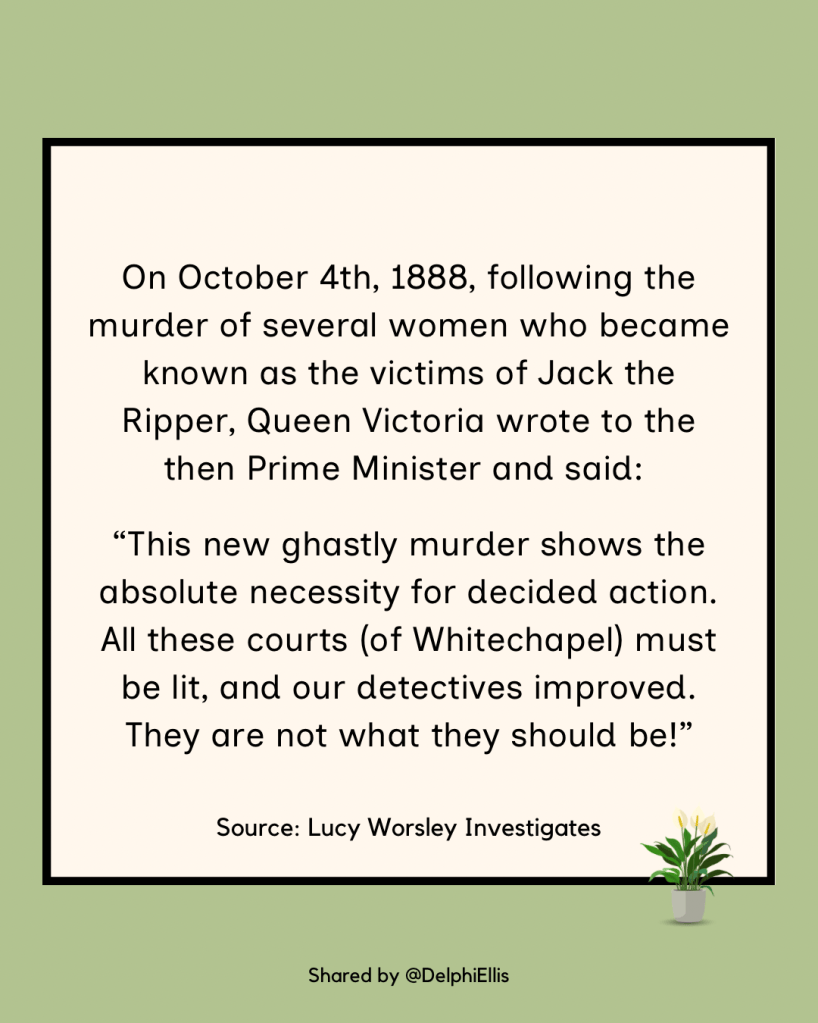
For a long time, sex work became an obvious way to live, especially if women had been turned away from the workhouse. This of course, presented its own dangers, although as Rubenfold also evidences, many of the women known to be Jack the Ripper’s victims in the late 1880s, were unlikely to be sex workers but in fact women just trying to survive, and even escape abuse.
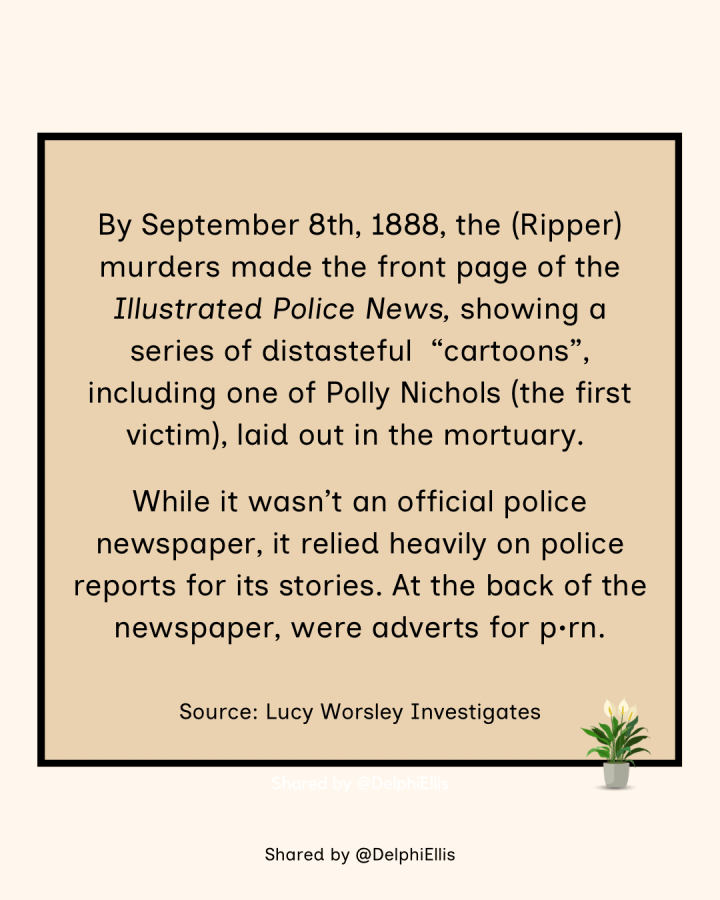
As shown above, even if a woman did leave an abusive husband at that time, she was treated with little if any sympathy or respect – even in death.
If a woman was married, and she did manage to leave safely, it wasn’t until the Married Women’s Property Act was passed in 1870 that she was allowed to keep her earnings and some property acquired after marriage as her own.
She still had little rights until the Equal Franchise Act of 1928 granted equal voting rights to women and men ( where both women and men could vote at the age of 21). The first general election that women were allowed to vote in was 1918, but only if she was over the age of 30 was a “householder, the wife of a householder, an occupier of property with an annual rent of £5, and a graduate of a British University…”. Until The Sex Discrimination Act was passed in 1975, British women did not have the right to open a bank account, have a credit card, or take out a loan (including a mortgage) in their own name.
Even with these advances in legislation, current data estimates that around 940,000 women are victims of economic abuse in the UK, with nearly a quarter prevented from leaving an abusive partner because of it.
Today, there is no global number available for the number of women who engage in survival sex, but UK parliamentary research estimates roughly 50, 000 to 80,000 people (potentially up to 105,000 in broader estimates) are involved in sex work today, with women making up roughly 88% to 90% of the total. “74% of women in prostitution identify poverty, the need to pay household expenses and support their children, as primary motivators… For some women involved in prostitution it is their partner who coerces them to become involved, profits from it as their ‘pimp’, and prevents their exit”.
Lack of money, no recourse to public funds and even fear of criminalisation, is still a barrier to leaving – and safety – today.
3. Health
In the UK, women gained widespread access to contraception through the National Health Service (NHS) in 1967. The act enabled local health authorities to provide family planning advice and services to a wider population, previously limited to women whose health might be at risk from pregnancy. The contraceptive pill was introduced in 1961, but the 1967 act made it more readily available through the NHS. This feels like progress, and for many women it’s been an important part of their liberation.
However, although the law appears to be changing, abortion is only legal in the UK if certain conditions are met; a woman still doesn’t have full autonomy over her body or health choices, particularly in early pregnancy. At the time of writing, in certain parts of America, it’s been reported that termination of pregnancy is illegal, regardless of the circumstances.
The latest reports also show that rates of medical misogyny in the NHS are eye-watering, where women have tried to seek medical help and been “dismissed, ignored or not believed”, with an alarming number even told “it’s all in your head”.
Women’s safety is at risk today when her right to unbiased, non-judgemental healthcare is still up for debate. And if Roe vs Wade teaches us anything, it’s that laws can be overturned.
4. The Law
In England and Wales, marital rape only became a crime in 1991. Prior to this, consent for sexual intercourse was considered “implicit in the marriage contract.”
Coercive control became a criminal offence within an intimate or family relationship under Section 76 of the Serious Crime Act 2015. However, there still seems to be a general lack of awareness of what constitutes coercive behaviour (even among some professionals), which includes manipulation (such as making her feel guilty to exploit a response), gaslighting (designed to confuse her and what she knows to be true), isolating a woman from her family and friends, and making her do things she doesn’t want to do in any capacity, from financially to s*xually.
But the challenges don’t end there.
A law had to be created that made the act of taking a s*xually intrusive photograph up a woman or girl’s skirt without their permission illegal, which came into effect under The Voyeurism (Offences) Act 2019. As technology evolves so does the danger. The more women adapt to it, the more ways violent men find to harm.
The Domestic Abuse Act receive Royal Assent in 2021. The Act establishes a legal definition of domestic abuse, clarifying that it encompasses more than just physical violence, including emotional, coercive, controlling, and economic abuse. It includes offences such as stranguIation and threatening to share explicit photographs, however it still doesn’t appear to make domestic abuse (ie being terrorised in your own home) an offence in itself.
Despite all these laws, in 2025, 83,000 women were intentionally killed globally, with 53,000 killed by an intimate (male) partner; that’s 137 women and girls every day. In the UK, as of March 2025, 6.3million women have been r*ped or s*xually assaulted since the age of 16, usually by someone they know. In March 2026, CNN reported on an online “r*pe academy” which identified millions of visits to a website containing more than 20,000 videos, where men had drugged their wives and girlfriends, filmed himself – or others he had invited – r*ping her, and then streamed it on the internet.
A system that does not prevent, nor rehabilitate violent men, including the mindset and behaviours of misogyny and narrow masculinities, is not justice for women. It’s not protection for women. And it’s not safety for women.
5. Societal Attitudes
Some people may still insist things are “better than they were.” But the evidence speaks for itself and begs the question whether societal and decision maker attitudes today about men’s violence really have changed, if they’ve just changed shape, or are even regressing. Recent studies, regarding the prevalence of misogyny in online spaces, would suggest the latter.
The normalisation of violence shows up in myriad ways, from the language we use to celebrate someone’s success – today people say “they’re kiIIing it!” – to the way that society will continue to make excuses for violence some men choose to use.
While in some quarters, there may have been a shift in terms of placing the responsibility on the harm doer, in other parts of society (and some institutions) a culture of victim blaming still exists, and one that may even collude with the perpetrator.
Nothing changes if nothing changes; if we want something different we have to do something different. Maybe that starts with recognising that we have not, in fact, “come a long way”.
I am not free while any woman is unfree, even when her shackles are very different from my own. – Audre Lorde
© Delphi Ellis – All rights reserved. This is an opinion post which may appear on other websites or platforms affiliated to the author. For full terms and conditions of use, please visit the policies page.
Sources:
- **Domestic Violence Services Network

