
This is an opinion post and discusses violence from the outset.
Let me start by being clear: what follows is not knocking the energy behind the White Ribbon campaign itself, nor the men who started it (nor men in general). Genuinely.
I talk about male violence against women in my spare time (unpaid by choice), because it’s a conversation we need to have, and a cause close to my heart. I am aware there are men and others doing good work in this space, to help make the world a safer place for all of us.
But there is a problem.
Last year, on 25th November, myself and others helping in the MVAWG arena, noticed that some men (not all) took to their social media, to make “pledges” and take “oaths” on White Ribbon Day.
The problem is, if all that happens is a 30-second sound bite or paper pledge at some point during that 24 hours, that doesn’t become a springboard for meaningful action the other 364 days of the year.
But there’s more.
White Ribbon Day is actually the same day as the International Day for the Elimination of Violence Against Women and Gender-Based Violence, also known as IDEVAW.
IDEVAW names the problem (mostly, I’ll come back to that) by stating that this day is about violence against women – whereas the name “White Ribbon” doesn’t.
At this point, if you know some of the history, you might say that the White Ribbon Day campaign, originated in Canada using 25th November before IDEVAW, and you’d be right.
But the 16 days of activism, which also start 25th November, actually began the same year (1991), and female activists had used that same date since the 80s, to talk about the reality of male violence against women.
The whole point of the day was to highlight the harm some men do, to hear the voices of women who have been impacted by it, and the challenges they face as a result.
It asks men not just to listen to women, but take responsibility for the harm some men choose to do, and to be part of the change that addresses it. It is recognition that men are often in the best position to challenge the mindset of misogyny and harmful ideology that shows up when their mates use gateway “banter”. It is ultimately a day for men to sit down and hear women, and then demonstrate that they get it, and will do all they can to help.
Yet I fear this has been lost along the way.
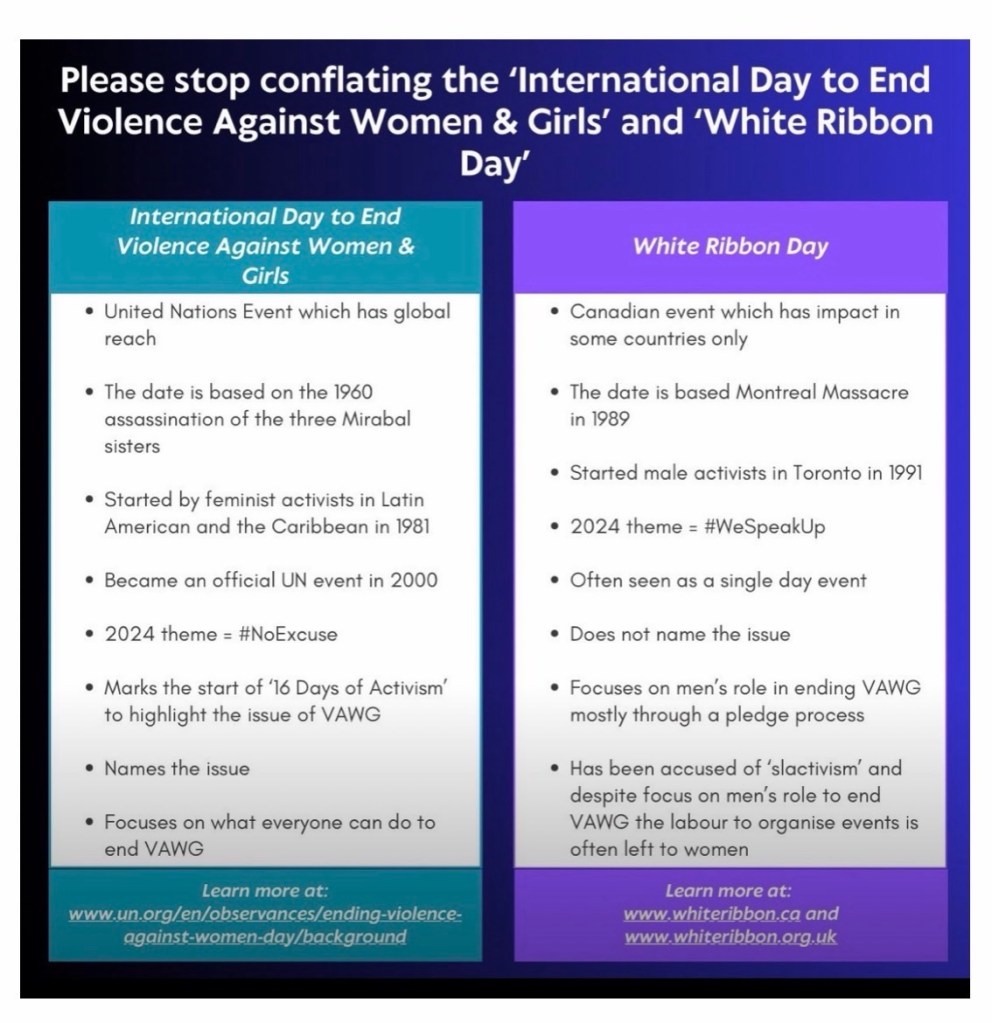
The name “White Ribbon Day” also makes male violence invisible – and as a point of note, so does IDEVAW when it fails to include the word “male”.
This does matter because the awareness days using 25th November came about because of the murders of women, by violent men. Men are the predominant perpetrators of violence against women, just as they are also the predominant perpetrators of harm against men.
We have to name it to tame it.
There are those who will say that some women hurt women and girls too, and some women hurt men – that’s also correct, even if they are outliers and in the minority. But 25th November is about the harms some men do to women.
If it was called White Ribbon Day for the End of Male Violence Against Women, or the International Day for the Elimination of Male Violence Against Women (IDEMVAW), it would reflect its true purpose and original intent.
Having said all this, neither White Ribbon Day nor IDE(M)VAW is intended to shame men, or say it’s “all men”, nor imply that women need men to protect them. It asks simply that men do their part to shift the narrative away from narrow ideas of masculinity that hurt men too, and show safe upstandership towards men, where appropriate.
What we permit we promote.
Something is better than nothing, right?
Any awareness day that doesn’t name the problem, perpetuates it. What we resist, persists. So a day that doesn’t name its purpose falls at the first hurdle. If we want to end male violence against women, let’s say that.
It also depends what that help looks like.
What the moment doesn’t need right now is more “White Knight” thinking, especially when it positions only men as the “protector”, yet fails to say who women predominantly need protecting from. (Incidentally, research shows that some T€mplar (“white knight”) symbolism is increasingly used in some extremist rhetoric).
The label of protector also places men inside the Man Box, especially when it’s driven by power and status-seeking, rather than learning and connection. They may benefit in the short-term, but in the end that hurts them too.
Something is not always better than nothing, especially if that something is empty of substance. As Mona Eltahawy says (taken from the Before and Beyond report): “I don’t want to be protected, I want to be free.”
One last thing …
There are some who may read this and be offended, as if we should just be grateful that men care for a day, and be quiet, or worse will direct their anger at women (or feminism) for daring to speak up. If that’s the case, the bar is definitely too low. It would also ironically make the point that while not all men are dangerous, some definitely want to maintain the status quo. Women shouldn’t become a target for sticking their head above the parapet.
The thing is, a lot of men do care and maybe just don’t know what to do. So this is simply asking them to listen and act helpfully, – to not talk about us without us – rather than decide what we need. If it’s “his way or no way”, then the support was conditional and never about helping in the first place.
To emphasise again, this article is not saying White Ribbon Day as a campaign is bad or even wrong, or that the intention was ever to centre men.
But it is fair to say that it has been interpreted that way by some – an opportunity for token posturing once a year, without any meaningful action or change.
If men aren’t interrogating their biases and behaviours towards women, while making their “pledge”, then it’s just a performance. Male allyship, if that’s what we’re calling it, is a daily practice to challenge the system they benefit from.
I am – genuinely – grateful to the men who understand and are showing up every day; my thoughts here include appreciation for them.
With all that in mind, here’s some food for thought:
💡See if you can view the problem holistically: join the dots between who the predominant perpetrator is – violent men – and the mindset and ideology behind it.
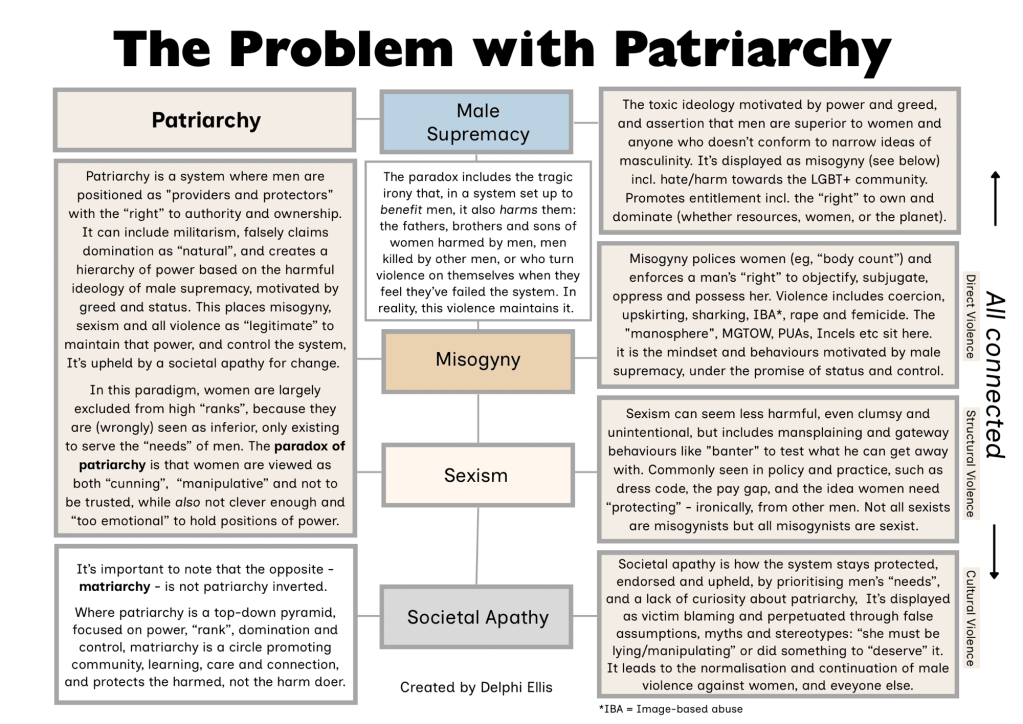
💡 Take time to learn about misogyny and the overt – and covert – ways it shows up in systems and policy, including dress code and the gender pay gap, (even if some think we’ve come a long way.)
💡Teach pacifism as a path to wellbeing, alongside promoting the 5Ds of bystander intervention to make it safe(r) for people to step up and step in. Where it’s safe to do so, challenge harmful and unhealthy narratives that aim to assert power and control particularly over women.
💡Set healthy values at an organisational, workplace and even family level, that make it clear what will – and won’t – be accepted in an enlightened society.
💡Recognise this is a societal problem – a moral issue – not a psychological one, and how all types of hate and harm intersect – misogyny, like racism, is not a mental illness. Address direct violence – including through the words we use – as well as institutional and structural harm.
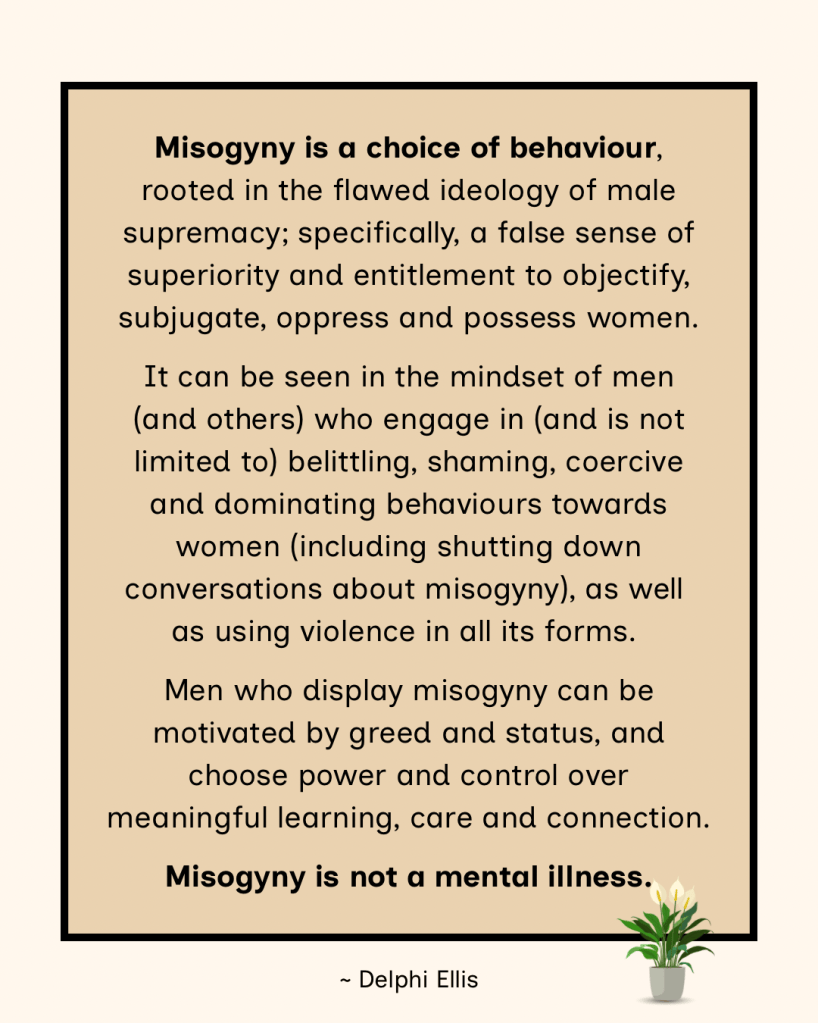
Racism, homophobia, ableism, transphobia and all forms of hate and harm (including war, domestic abuse and human trafficking) are also not caused by “loneliness”, but harmful beliefs about the “right” to dominate, own and control. Reject ideas that seek to objectify, subjugate, oppress and possess women.
In the end, we can work together to make the world a more peaceful place for all of us. But that will take more than an oath in a soundbite, on just one day of the year.
© Delphi Ellis – All rights reserved. This is an opinion post which may appear on other websites or platforms affiliated to the author. For full terms and conditions of use, please visit the policies page.

