

This is an opinion post offering food for thought, and references male violence from the outset.
I’ve written before about male violence against women and that this is a conversation we need to have. I’m not new to this topic; I’m someone who has been helping in the arena for more than a decade, having worked with the bereaved for more than 20 years, including those bereaved by male violence. I am also someone who has spoken openly about being subjected to it.
As another “VAWG Taskforce” is announced (there was one several years back for policing), and as someone who has historically had quite a lot to say about what needs to improve for those harmed by violent men, I’ve offered some ideas below.
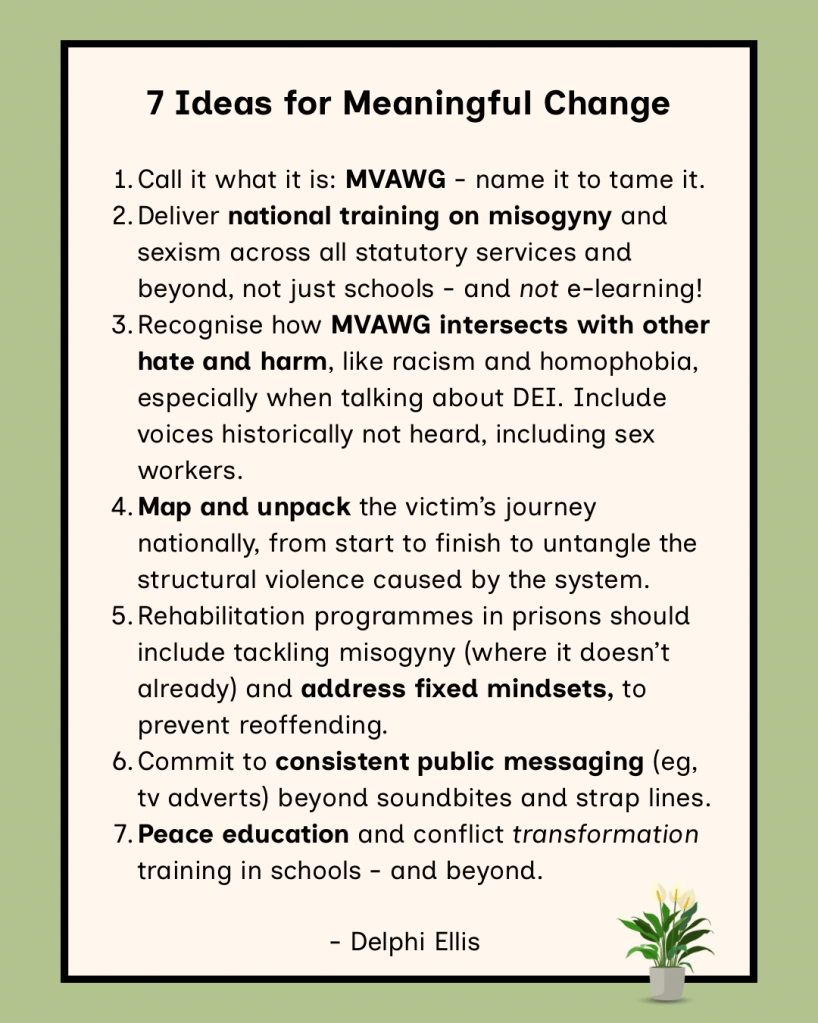
Personally, I’d like to see:
1. 🫵 The government commit to calling this specific crime type what it is – male violence against women and girls (MVAWG), because it is predominantly perpetrated by violent men. This framing ensures the perpetrator is held to account from the outset (see commentators like Jackson Katz).
Name it to tame it.
2. 📝 National training on misogyny and sexism across all statutory services and beyond, not just in primary/secondary schools – and not through e-learning!
Violent men are already out there – so there needs to be a commitment to educating them, and everyone else. This will also help address culture.
For example, training needs to explain how misogyny is different to sexism, even though one upholds the other. It should include discussion that r@pe is not about lust or even s€x, but a mindset motivated by status and power.
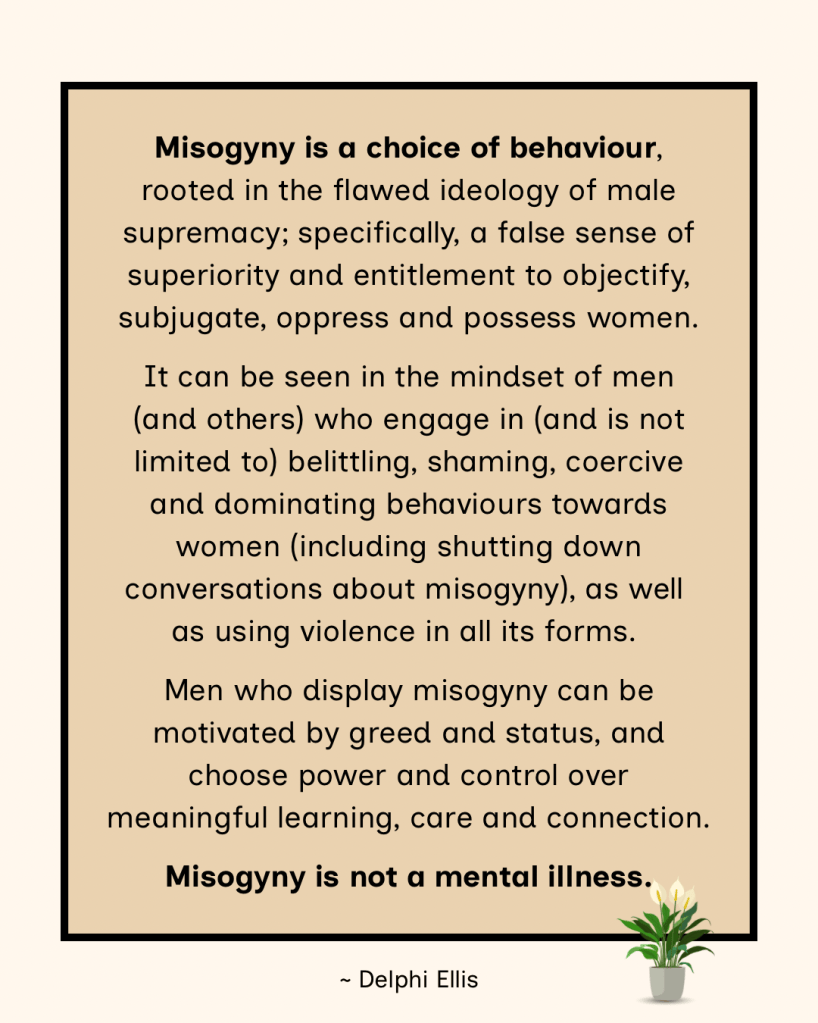
We also need to recognise that misogyny is not a mental illness, just because the dictionary definition of it usually refers to “hate”, but that male violence is a choice of behaviour. This would need a wider discussion about how narrow ideas of masculinity hurt all of us, including men. (See the work of authors like R.W. Connell and Cynthia Enloe, the latter in the context of militarism.)
3. 🔀 Recognise how MVAWG intersects with other hate and harm, like racism and homophobia, particularly when talking about DEI. Include voices historically not heard, including s€x workers (see the work of Raven Bowen).
4. 🗺️ The whole experience of the victim’s journey needs to be mapped and unpacked nationally, from start to finish to untangle the structural violence caused by the system; not just the CJS, but in the National Health Service (in the UK) and in Higher Education (see reporting on the “Cornell 7” case).
This also requires an understanding that while pockets of good practice including in RASSO Units do exist, it’s a postcode lottery for care and support for victims from the outset and we should ask if there are even inconsistencies about how the law is applied.
Otherwise the system focuses on a negative peace, simply striving to remove the next violent perpetrator, while women live in the hum of threat of violent men who haven’t been caught by it yet. This (and the distance between harm and harmony) is what I call The Peace Gap.
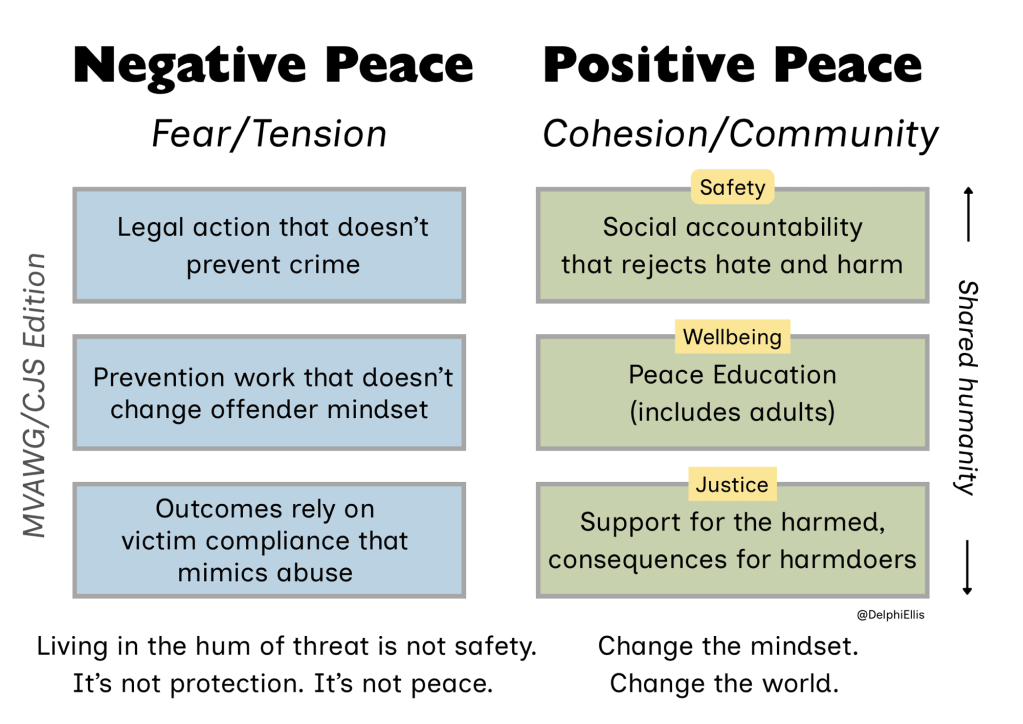
Not every victim wants their day in court, but are traumatised by the process anyway.
5. 🔃 Rehabilitation programmes in prisons should include misogyny (where they don’t already) and address fixed mindsets (see the work of Carol Dweck), to prevent reoffending (see cases such as Bear, Shepherd, Levy).
They also need to address the mindset and ideology of male supremacy and entitlement. As male supremacy is also an ideology, this would require a complete review of Prevent with that in mind, given we know the links between domestic abuse and violent extremism. (See the work of authors like Joan Smith).
6. 📢 Commit to consistent public messaging beyond soundbites and strap lines. TV commercials on our telly sets and phones at peak times, calling out harm doers (not weird campaigns about snakes. IYKYK).
7. 🕊️ Peace education and conflict transformation needs to be delivered in schools – and beyond. Conflict transformation (see the work of John Paul Lederach) is not just about “resolution”, or solving the immediate problem, but providing justice and preventing future harm.
Pacifism, where it isn’t already on the curriculum, can help reject the ideology of violence, and hate and harm in all its forms, and centre wellbeing – for everyone.
These are just some ideas, and of course many will say it’s nuanced and depends on resources, in an already strained economy (despite billions going into military spending, in case of a war no reasonable person wants).
That said, nothing changes if nothing changes; if we want something different, we have to do something different. Otherwise, if we always do what we’ve always done, we’ll always get what we’ve always got.
At least, that’s what I think.
© Delphi Ellis – All rights reserved. This is an opinion post which may appear on other websites or platforms affiliated to the author. For full terms and conditions of use, please visit the policies page.


One thought on “Another “Task Force”? Here’s 7 Ideas for Meaningful Change in the MVAWG Arena”
Comments are closed.