

This article discusses violence from the outset.
If you’ve ever heard of some very dodgy experiments, like one about “electrical shocks” conducted by a man named Milgram, or the one in a “prison” conducted by Zimbardo, or where no one did anything during the horrific murder of a lady called Kitty Genovese, you might want to read this book.
For years, I’ve suggested that what we think we know about the original “findings” of these events, is not as simple as it first sounds.
In fact, years ago, I wrote an article about Kitty Genovese – particularly the so-called “bystander effect” that came to be discussed after her violent death – and what we now know to be the inaccurate reporting at the time that decades of research was then built on (I recently re-published the article here.).
If you didn’t know about Kitty’s case, the original story went along the lines that at the time of her brutal attack and subsequent murder, people did not come to her aid.
As a qualified counsellor, trained in a model that believes in glorious human potential, the story of Kitty being abandoned by her entire community – that they looked the other way as she cried for help – never sat well with me.
When I researched her case, I was reassured to find, contrary to popular opinion, they didn’t.
Some called the police (who apparently didn’t come until it was too late), one shouted for her attacker to leave her alone, and one woman, Sophia Farrar (also a close friend of Kitty) on hearing she was in danger, immediately ran to help. Kitty died in Sophia’s arms.
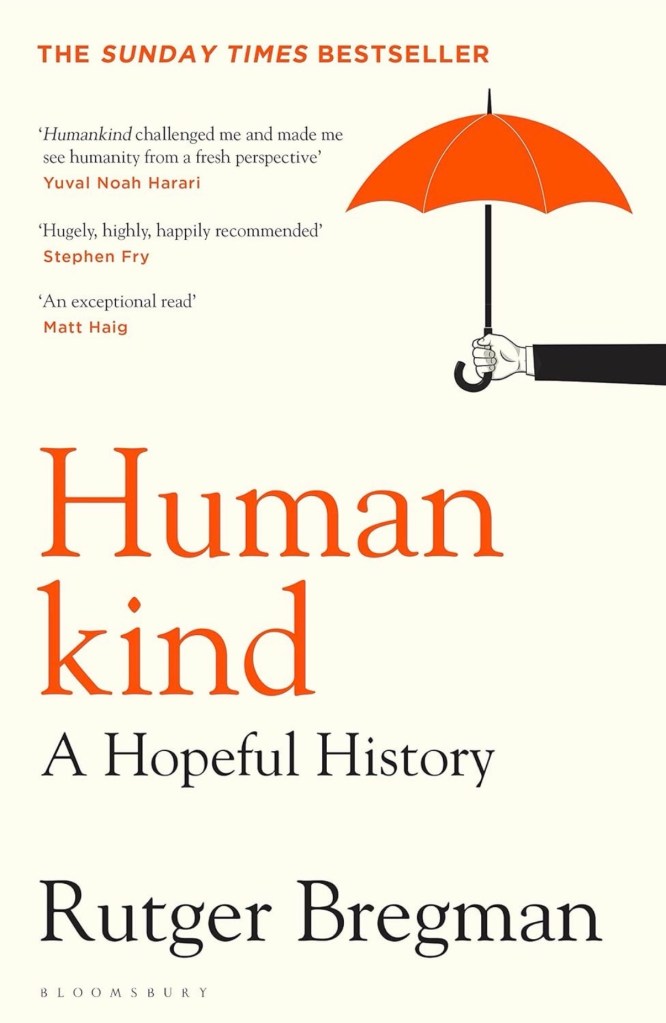
It was validating then, when I gratefully came across this book by Rutger Bregman, which summarises everything I was saying in one place. (He covers more topics than this, including propaganda around war, which are also worth a read).
Here’s a short summary with the above in mind:
1) If you’re not familiar with Zimbardo’s and Milgram’s experiments, these were widely interpreted as “evidence” that cruelty is a near-universal human trait.
Yet, while the experiments did show some people could be significantly coerced and pressured into committing harmful acts, especially if they were told it was for “the greater good”, others rejected the idea of hurting another for the sake of it. When this and similar experiments were investigated a little deeper, researchers found none of the participants were inherently violent and in fact in one case, rather than turn on each other, one group created a pacifist commune (I kid you not).
The evidence actually points to the fact that while humans may have the capacity to express violence, and men in particular can be socialised in to believing it’s their “right”, it is not inevitable or “in their nature”.
2) The idea that sprung from Kitty’s murder, and has been widely asserted ever since, was that people don’t stand up in a crowd. But as my own investigation and Bregman’s showed, the reporting at the time was inaccurate. In reality, when the moment required it, people did – and do – step in. People do report, it’s what happens next (and how the system treats them) that seems to let people down.
What this, and other research emphasises is that humans are born – and predominantly stay – nice people; they also have the capacity for peace. It’s only when they are told violence is necessary or, worse, that it is their right and comes with a prize, that some men may be tempted and choose to use it. (The subject of male violence is a conversation we need to have.)
So I actively encourage people to revisit what they think they know about these ideas. You might be pleasantly surprised and equally horrified at the tales we’ve been told over decades, especially the idea that “men just can’t help themselves”.
They can. And often, they do.
© Delphi Ellis – All rights reserved. This is an opinion post. For full terms and conditions of use, please visit the policies page.


One thought on “Humans are actually nicer than you might think (or, at least, may have been told)”
Comments are closed.